Three is a Magic Number
Mary Jule Greeley Durkin, 1934-2017
With the publication of “The Suburban Woman, her changing role in the church” in 1972, our mom Mary Jule Greeley Durkin became a published author, and over the next 30 years, she wrote or co-authored a dozen more books in the field of pastoral theology. Her final book, which she co-edited with the man she always called “her much older brother,” was titled: ‘The Book of Love: A Treasury Inspired by the Greatest of Virtues.” In thinking about what we should say this evening, we found our inspiration looking through the book’s chapter titles.
Chapter Two: “Young Love/Falling in Love”
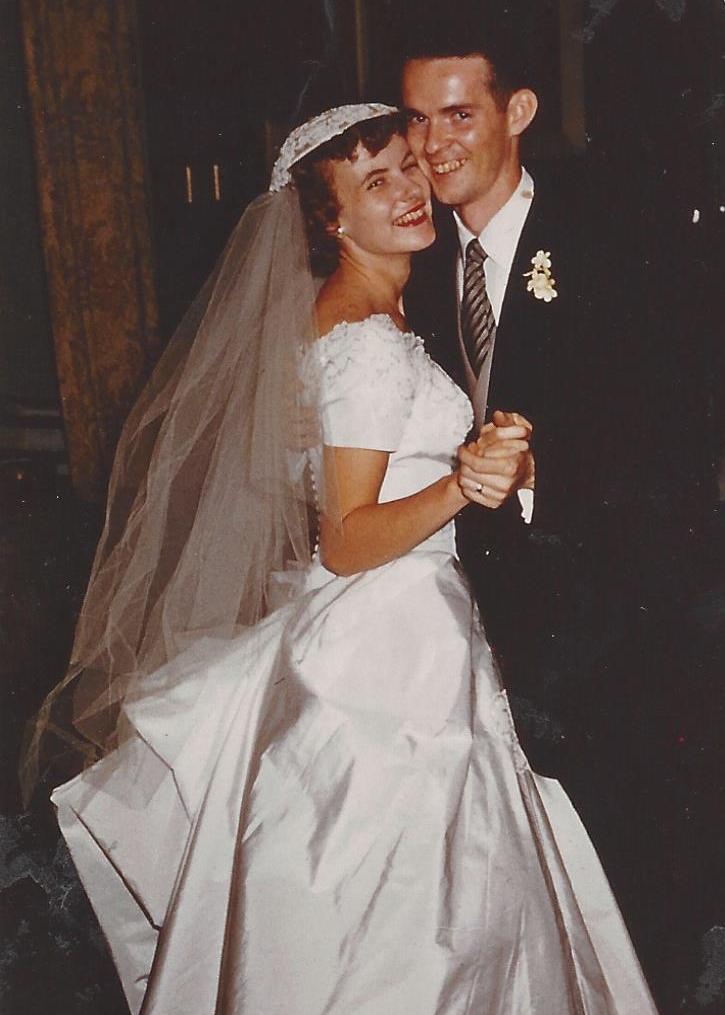
Our parents were set up on a blind date in 1951 by their friends Pat Freely and Jim Daly. Our dad made a joke about not paying for her bus fare, and he was polite to her mother. Humor and kindness were apparently the key to our mom’s heart. Jack and Juice – the nickname he always called her - dated for five years. She entered college. He was drafted into the Army and spent time away from Chicago, but their young love survived. At her mother’s insistence, they waited until she finished college to marry. Two months after she graduated from Mundelein, they tied the knot on Aug. 11, 1956. They moved into an apartment on the North Side, and she began teaching first grade students at the Brown School.
Chapter Three: “Married Love.”
What happens to young love when two people get married and within ten years, have seven children? For our parents, the answer was: it turns into something deeper, more grounded in reality-- something occasionally bruised, but never broken.
One of the constant themes of our parent’s marriage was the travel they did thanks to Dad’s job at United Airlines. They flew the Concorde to France, sailed the QE2 across the Atlantic, and explored the Amazon rainforest. They frequently travelled “home” to Ireland to visit the Mallee and Waldron cousins, and soaked up the Hawaiian sun with Mom’s friend Bea Isemoto, a fellow teacher at the Brown School, and her husband Larry. All those the trips they took together provided them with ample opportunity for time as a couple, sharing meaningful experiences that strengthened their married love.
After our dad got his first cancer diagnosis in 1981, our mom devoted herself to nursing him back to health after every surgery. As long as he wanted to keep fighting, she stood by him. And when he let us know he was done, she accepted his wishes with grace and compassion. Because she knew that thirty-eight years together had tempered their married love into something that was stronger than Death.
Chapter Four: “Family Love”
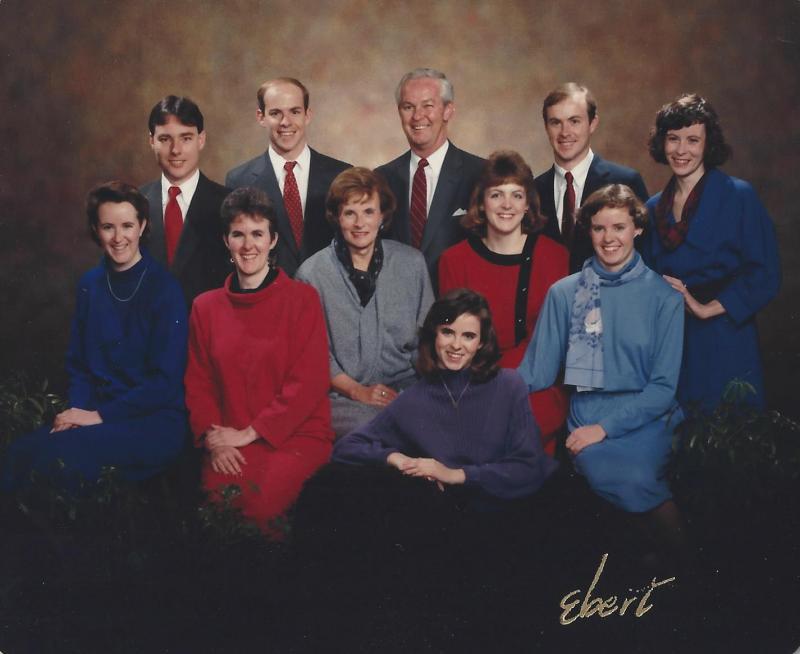
Considering there are seven of us, our mom had to have a very big heart to love and care for each and everyone one of us as she did throughout her life. While Elizabeth talked about the vacations she took with our dad, they didn’t always leave us at home! We took family vacations to Hawaii and California and many places in Europe. We must have been quite a sight, all nine of us walking on to those airplanes! And of course our many summer vacations in Grand Beach, Michigan.
To keep the family connected with each other as we grew older and moved out of the house, she would sit down, with love, every other week or so and compose what she called the Durkin Family newsletter – the 80’s version of the Facebook group page! We read some of these to her this last week , laughing particularly about her updates on Chicago sports teams, especially in 1984 when she was planning a surprise birthday party for Fr. Cusick and was slightly worried that he might miss his own party if the Cubs continued on in the playoffs!
Chapter Five: “Friendship”
It shouldn’t be a big surprise that our mom had a lot of friends, many life-long. She treasured those friendships with her high school friends, her college friends who called themselves “Club”, her prayer group friends from Park Ridge, amongst many others. She demonstrated that love for them through hosting parties, traveling with them on weekend trips and celebrating with their children in their life events.
Chapter Seven: “Love of the Neighbor and the Stranger”
While family and friendship love is “typically” easy, love of neighbor and stranger can be more difficult, but not for our Mom. She demonstrated this type of love through her dedication to charitable and civic causes throughout her life. These included the Catholic Area Lay Movement and the Cana Conference of Chicago in the 60s and 70’s and then her more recent work with Concern Worldwide and Galway Sister Cities. She instilled a sense of the importance of loving neighbor and stranger in all of us when we were young. This sense of service and giving back to the community has continued in us and has passed on to her incredible grandchildren as well!
We also like to think that her role as a teacher, a writer and a lecturer shows her love of the neighbor and the stranger. She taught at Loyola and DePaul universities, and even commuted to Ohio to teach at the University of Dayton two days a week for a period of time. She also lectured at various religious conferences and parish missions all across the country, educating neighbors and strangers along the way.
Chapter Ten: “ Love: The Divine/Human Encounter”
Here in Chapter Ten, we find the material that inspired our mom’s professional life. If I have the story correctly, and I admit I may not, one day she found herself daydreaming about my sister Laura marrying John John Kennedy – and she realized that she needed to find something fulfilling outside of her role as a mother. Pregnant with her 7th child, she became the first Catholic woman to enter the doctoral program at the University of Chicago Divinity School. She was hungry to learn more about her faith and to learn how to translate the tenets of that faith into a pastoral, practical theology that could guide the daily lives of the post-Vatican II laity. She started the Ladies Theology program at our suburban parish, Mary Seat of Wisdom, because she believed there was an audience of women who had an interest in becoming more informed about the Church from the new perspectives that were emerging during that era and who, as long as you provided them babysitting, would come out to learn from a wide variety of speakers. And while some people thought her idea would never work, it gradually grew into the “Theology of Park Ridge,” which celebrated fifty years last year. Her belief in lifting up the voice of women was given a platform here at OSP when she had the opportunity every year on Mother’s Day to share her thoughts from the altar on the experience of being mothered and on the wisdom of Mary, the Mother of God.
Another way that she translated her lived experience into scholarship was her work on the theology of marital intimacy and human sexuality. Inspired by the revelation of God’s divine love that she encountered in her own marriage, she strived to help other married couples come to understand how the human passion to connect with another person reflected the passionate love of God for creation. She saw human love as something that intricately entwined two people, not unlike the knot work we see on the walls of this church. It is no wonder that she later developed an interest in Celtic spirituality and worked to create a center here at OSP to explore how ancient wisdom could inform modern life.
The Unfinished Chapter:
And now we turn to what we are calling ‘The Unfinished Chapter.” She left it to us to write about this final chapter of her life and about the love she demonstrated to us throughout it.
Over the last fifteen years or more, Alzheimer’s disease gradually stripped our mom of her faculties, until she had lost all ability to manage even the basic activities of life, to feed herself, or even to speak. At that point, many people would have judged that she had lost all of the capacities that make one a productive member of society, that give one dignity, some would say even that make life worth living at all.
But she kept living. Every morning, she woke up and she continued to participate in Life. And it went on for so long under such difficult circumstances that the question couldn’t be avoided: “Why?” “What could possibly be making her keep going?” After much reflection on the question, it became clear that she had been answering it all along, if we would have been paying more attention. Her answer was simply: “Well, why wouldn’t I?” Because what she knew, and what she was trying to teach all of us in those last difficult years of her life, was that the essential thing that makes any life worth living has nothing to do with accomplishments or abilities. Human dignity is only– and has always been only -- about something you are: a person who is capable of loving and being loved.
And being in loving relationships with others requires only one thing – that we be present. That we wake up and are there for the people who need us to love them, and who need to love us. We don’t need to be able to do anything for them, we don’t need to be able to say anything to them, we just need to be there -- if not physically, then emotionally and spiritually. Love requires nothing else than that in order to be abundantly productive.
Last week, the time came – as it does for all of us -- when our mom couldn’t keep waking up. But that doesn’t change the fact that up until the end, she remained a teacher - teaching us that the opportunity to continue to be in loving relationships with those she cared about made everything worth it. Let us all learn that lesson and carry on her legacy.

Copyright 2017 Durkin Murphy Family. All rights reserved. The editor is solely responsible for this content, and the rest of the family is probably only too happy to pretend they don't know her.